Underwriting Pirates
Silicon Valley’s love affair with ‘Navy’ founders signals institutional aging—but new asset classes await those willing to solve the problem.

Sam wrote a few weeks ago that Silicon Valley needs to get back to funding pirates, not the Navy… I think this idea deserves more attention than it gets, and that its implications range far beyond Silicon Valley.
It’s not just about who Sand Hill Road investors are more inclined to back, it’s also about who–and how many people–we rely on to stay innovative as a society.
Only letting the Navy drive that effort means capping our creative potential—and missing out on some lucrative MOIC as far as investors are concerned.
Why is that, and what do we mean by the Navy vs. pirates? Empirically (and metaphorically), the Navy operates within a chain of command, and its members rise to prominence by following rules; emphasis is put on expertise and experience. Pirates, on the other hand, are outsiders who constantly challenge the prevailing doxa. Their ethos is defined by ingenuousness, even naiveté, and we know for a fact that this is where innovation thrives1.
One only needs to look back at history to get evidence. ARPA, the precursor to DARPA , was one of the most successful institutions at backing risky, unconventional projects that no one else wanted to fund. Its willingness to bet on ‘pirates’ led to technological revolutions like the Internet and GPS. Fairchild Semiconductor was also founded by a team of 8 young PhD graduates who became known as the traitorous eight after they resigned from Shockley Semiconductor. Intel, AMD, Xilinx, Altera, LSI Logic, and National Semiconductor are all considered “Fairchildren”.
But is today’s situation really surprising? Probably not. Michael Gibson would argue Silicon Valley is simply showing signs of what he calls institutional aging, a pattern that is observable across all types of organizations:
We should acknowledge that there are hallmarks of aging in every institution. One of them is the accumulation of special interests; one of them is that the grants only go to older established people, i.e. a group of friends awarding each other grants; another thing might be this hyper specialization that prevents outsiders from judging how insiders operate, so we just assume they are smart and they should keep doing what they are doing.
The first step to reverse venture’s institutional aging is making sure the “grants” do not go only to older established people (the Navy) but to any smart, driven founder with great ideas and potential that could get catalyzed by being placed in an innovation sandbox.
The innovation sandbox: minimum material means and validation.
Most often, great ideas and human potential aren’t enough. They need the right context to materialize. I believe this mostly comes down to two things:
Minimum material means… You want to be able to build, and not get distracted by a lack of basic resources.
Validation (“signaling”). You also want someone to reinforce the belief that your idea is worth pursuing. This may sound trivial, but this piece is probably at least as important as the first one. Exceptional founders will often look like they have irrational self-belief, but the truth is that most of them had people at some point who believed in them and their ideas—even if that only came after a lot of skepticism.
In a sense, getting a check from an investor is the best way to check these two boxes.2
Now, we want to make sure this sandbox is not just open to Silicon Valley Navy founders, but to pirates as well. Luckily, a few attempts have been tried, and they offer great case studies Silicon Valley would benefit from studying more.
Welcoming pirates into the sandbox: Unpacking a few early attempts.
The Thiel Fellowship is the first one that comes to mind, and has been providing $100,000 grants to college drop-outs since 2011. The Washington Post reported in an article last year that 11 of the 271 Thiel Fellows have now founded >$1bn companies3. Some of these founders include:
Vitalik Buterin, founder of Ethereum
Austin Russel, Luminar Technologies Inc.
Paul Gu, Upstart
Dylan Field, Figma
Shahed Kahn, Loom
Lucy Guo, Scale AI and Passes
Robert Habermeier, Polkadot
Sean Henry, Stord
And the list goes on..
The Thiel Fellowship alone offers a whole lecture on the scale of the upside that can stem from underwriting talents nobody else was taking seriously. Today, tech would objectively look different may the foundation had not existed.4
Drive Capital, founded by Mark Kvamme and Chris Olsen, both former Sequoia partners, and which focuses on investing in early-stage and growth-stage companies primarily outside of Silicon Valley. The team has raised 5 funds so far (the last one being a $1bn fund raised in 2022), and some of its successes include Root Insurance, Branch, Duolingo, etc.
The 1517 fund, founded by Danielle Strachman and Michael Gibson (who both worked on the Thiel Fellowship), and which also focuses on backing dropouts, or “sci-fi scientists”.
The Z fellowship, launched by Cory Levy in 2020, and that offers $10,000 to potential founders who want to explore a project outside of school or work for a week.
Funnily enough, Levy has been removing the outsider/insider barriers very practically by sharing his cell phone publicly and connecting fellows (or potential fellows) with his network of world-class Z mentors.
He started doing that with First Text, and ended up connecting the founders of companies like Hebbia or Vise AI with mentors much before they went on to raise with prominent Silicon Valley investors.
The Advanced Research and Invention Agency (ARIA), a very exciting agency that the UK government recently set up to support high-risk, high-reward scientific research projects. The whole point of ARIA is to push researchers beyond their comfort zones and towards ideas the typically risk-averse British science funding system would deem improbable or downright weird.
The agency got awarded $1bn in funding for its first 4 years of existence, and its employees (“investors”) have been given an extraordinary amount of freedom over how and who it will fund: startups, universities, individuals.. anything is on the table.
Pioneer, an accelerator launched by Daniel Gross and Rishi Narang in 2018, and that pursued the mission to attract and fund people who were “weird and different”. The team stopped making investments earlier this year despite having invested in 150+ companies collectively worth over $1bn.
Last but not least, the work Slow has been doing with creators fits that framework too in a sense. Creators are likely to be outsiders from a Silicon Valley vantage point, but who have the potential to give birth to great innovations and businesses.
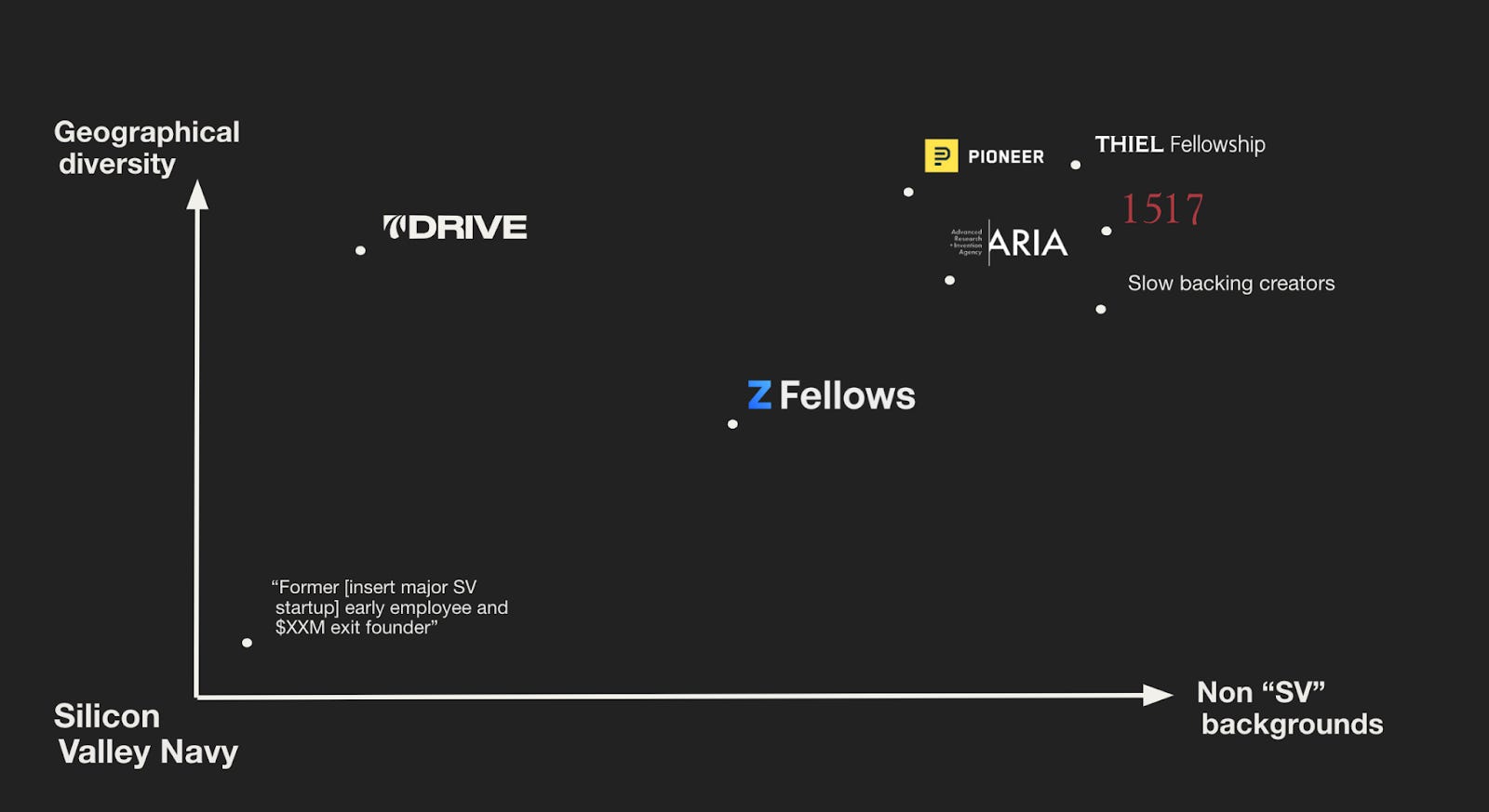
It’s relatively easy to map these different funds and initiatives based on their focus on founders with diversity of background or geography:
So what?
We’ve seen that initiatives have been attempted, and it’s now a question of scaling them, both in size and number. We need more first believers—not just in companies, but especially in talents. The solution is unlikely to be one ubiquitous talent underwriter, and there is room for new institutions to emerge that underwrite populations in which they have an underwriting advantage.
We’ve read several times that investing in people was emerging as a new asset class. The truth is that there might be a myriad of asset classes that are up for grabs by those not only capable of identifying these talents, but also uniquely positioned to underwrite them.
I got really enthusiastic about this spot-on X thread from Sam Altman as I was doing research. I couldn’t resist sharing some screenshots below.
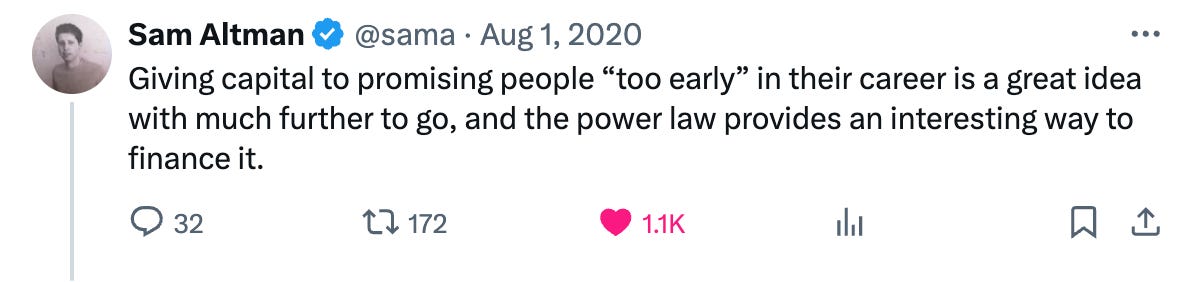
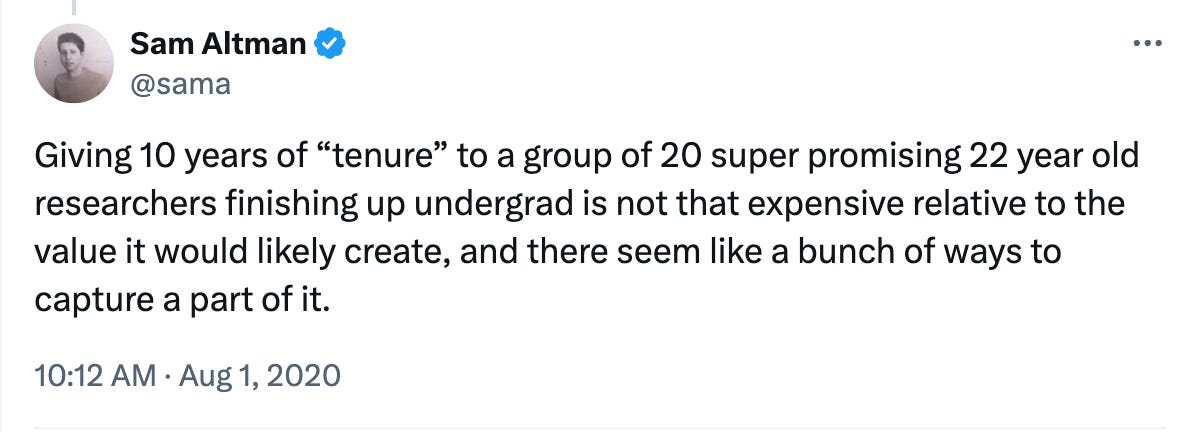
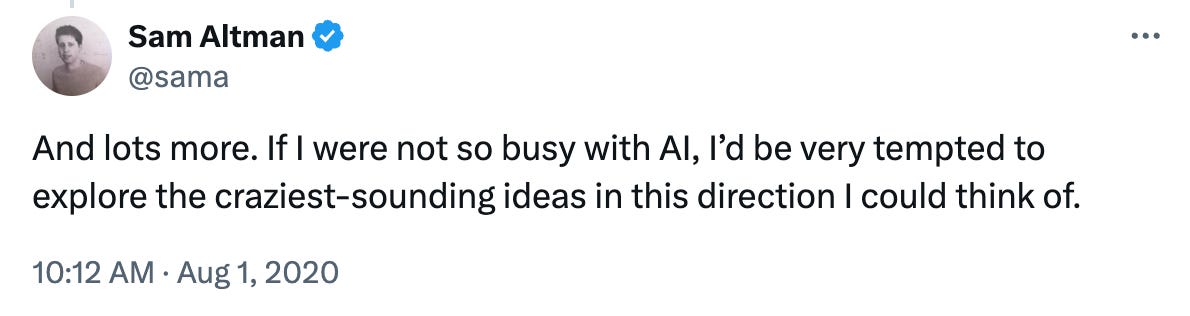
The tl;dr is some agreement around the fact that we barely scratched the surface of what we could do to unbound human potential and innovation. And that there’s room for some crazy ideas to get off the ground.
Back to the initial analogy, underwriting the Navy surely feels great, but relying on the Navy alone to drive innovation is a mistake—particularly because it has a tendency for incrementalism. We need pirates to participate in the innovation cycle too. We need smart, driven, and unorthodox thinkers who’ve been outside the Silicon Valley echo chamber—and we need to take these pirates seriously. That might feel like uncharted territories for some, but that’s the promise to treasured lands.
E.g., see Robert K. Merton’s work on the role of outsiders in scientific innovation.
Will, my partner at Slow, would argue otherwise…
It goes without saying that this number overlooks the many other innovations and accomplishments that stemmed from the fellowship.
As an aside, it’s interesting to note that Peter Thiel is both indirectly credited for creating this exceptional talent portfolio through the foundation, and directly credited for having done exactly that when founding PayPal; in a sense, that acts as a good reminder that great talent underwriting skills can have a lot of upside potential both for investors and founders.
So real! In the tattoo industry there's this massive new movement worldwide of "Scratchers" that are celebrity diy tattoo artists. A lot of them, especially in the UK, are jokingly calling themselves pirates. It's so amazing to be a part of it and watch it disrupt the industry norms.
Randomly came across the article while doing research. Love the "pirate/navy metaphor" - I'm going to quote this my writing!
How do we scale initiatives of backing pirates while avoiding the effects of institutional aging? Is it possible or is all scale susceptible to bloating?